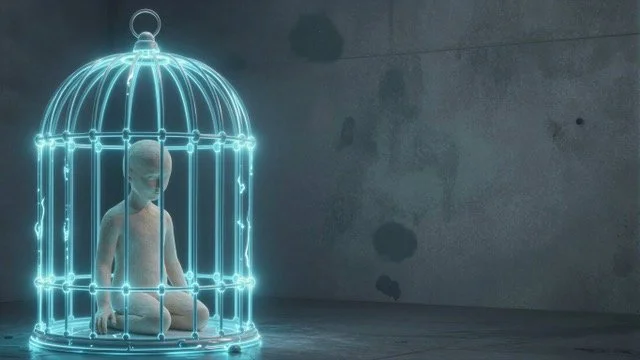
Open your mind - Open your wings
Trauma Therapy
in Roseville, CA
Reclaim your authority from the past to build autonomy via creative choices
It’s Easy to Identify the Starvation of the Body - but Not That of the Soul
The effects of childhood are hard to identify because you can’t go back and do it another way. You take who you are today for granted. “Is it just me, or is everyone else like that?”
You’ve pedaled hard to get out of where you were but still find yourself trapped in meaninglessness despite your achievements.
You may be an over-achiever, with standards nobody can match — yet still blaming yourself for not achieving everything you should or could have.
You may have become extraordinarily self-reliant because relying on others never felt safe — asking for support seems pointless
Perhaps your boundaries are so rigid that few people can get through — or so soft that you accommodate everyone else while struggling to assert your own needs
People may praise where you are and what you've achieved — without seeing the shark-infested ocean you had to cross to get there.

Looking back, you may see poverty — financial, intellectual, emotional — that left you with no choice but to adapt as fast as you could.
No chance for leisurely exploration or unpunished curiosity.
No luxury to negotiate boundaries — you learned to be submissive or feisty instead.
The narrowing of opportunities feels like personal failure, so you hide in shame.
You may carry an early wound — a sense of weakness and vulnerability that, if exposed, could return you to a profoundly powerless position. You do whatever it takes to avoid touching that wound we call childhood or developmental trauma.
Physical injuries we may accommodate. But emotional injuries — we hide.
You Take Charge to Find a Sense of Predictability and Safety
When you grow up parenting others rather than being parented, while achievement earns the attention rather than self-expression, you develop intense focus on others’ desires rather than your own.
Having your physical or sexual boundaries violated or being left without the care and protection you need—you blend in and survive: taking charge, making hard decisions, becoming agreeable, staying small. When danger is detected, safety becomes the priority, and you find it in taking control rather than relying on others. Control produces a sense of predictability, the prerequisite for safety.
High achievement may have become your way of taking charge and either gaining or avoiding attention in a socially desirable manner — yet it may have meant running away from something rather than toward an ideal that you freely chose.
As an adult, you take charge and make hard decisions for another “family”: your corporation, customers… society. You shoulder everybody’s pain and responsibility as if you were the only one who can do it.
Your empathy, wit to think on your feet, sense of duty and responsibility for others, and urgency to take action are some of your strengths running in overdrive.
Do you ever stop and wonder what’s missing from your life?
The Price You Pay for Safety Is Your Creativity
As a child, you had limited power: your brain was still developing, and you lacked the life experience to see the world in its complexity and make complex decisions. You grew up fast to meet the requirements of an adult world with your limited child resources. As an adult, you have retained that sense of inadequacy that you felt as a child, likely showing up as general anxiety, further confining your comfort zone.
You likely sacrificed opportunities for experimentation, exploration, and spontaneity: what we call “play”—where you can try your wings because participation matters more than the outcome.
A mind is naturally creative unless socially restricted, and creativity begins where the pressure for survival ends. Creativity is looking at options, preferences, alternatives, and genuine fit. Creativity assumes that safety is either given or not the primary focus of living.
With free exploration comes opportunity for a secure sense of self — autonomy: the ability to be selective, to say no, and speak your truth.
Depending on your gender, skin color, sexual orientation, age, disability status, you may be granted more or less autonomy by those higher in the social power hierarchy. In essence, your “childhood” may have never ended.
You can’t “just get over it,” pretend nothing happened, and be happy. Those old wounds became beliefs and behaviors that won’t leave without due process. You have to regain a sense of safety to develop autonomy: creating who you want to be and negotiating power.

Claim Authority and Autonomy Through Childhood Trauma Therapy
Developing your capacity for creativity (exploration) involves deliberate effort to overcome old fears of authority that you once submitted to or fought against. Old authority is perpetuated by your beliefs forged under the childhood pressure of limited options.
Healing through creativity and developing autonomy is a journey that can be taken in multiple ways: through relationships, engaging in arts, contemplation, or connecting with your spiritual guidance.
Therapy for developmental trauma is one sort of journey where you can use evidence-based assistance to become the author of your life by imagining options rather than following rigid prescriptions and daring to trust your own internal guidance as authority. Life review with a trusted other is more powerful than writing your own memoir in isolation and silence because our human mind is not meant to make sense of itself entirely alone.
Through our therapy dialogues, you can develop your identity from the inside out, learning to negotiate your needs with another person rather than feeling intimidated into submission, and intentionally course-correct when things don’t go according to plan. Just don’t give up.
Reclaim your authority from the past to build autonomy in the present, moving from instinctive adaptation to intentional choices.
Embrace an unalienable part of yourself: the powerless child that may be part of you, but not all of you. Overcome the fear of being found out that you are not as good as you think, and trust that what you may lack is not worth but the ability to see yourself for who you are.

Feeling Loved Is Not What Others Do to You; It’s What You Are Willing to Let In Regardless of What Others Think You Deserve.
As your trauma therapist, I honor your efforts to outgrow that longing for an unmistakable external truth that should have come from your parents.
But as an existential therapist, I won’t validate you: I trust you with that job.
Instead, I aim to explore your conflicting values and various options so you can figure out what you can live with and what you won’t. We can’t change what has happened, but you can align your future choices with chosen rather than inherited values.
What do I actually want?
What suits me?
What happens if I try something different?
What sort of life would I live if it was all up to me?
What masks should I take off — and what would I wear?
Ready to find your own answers?
Questions You May Still Have…
Don’t we all have childhood trauma?
Perhaps. Trauma is not an event but an experience. What feels traumatic, a wound in the heart and soul, is very personal, not readily identifiable from the outside.
If we all have it, is it still worth the attention?
Attending to a wound eases the pain, and knowing somebody cares eases the suffering. If we all attended to our wound instead of covering it up, perhaps we’d stop taking our feelings out on each other. Imagine what would happen if we stopped fighting with enemies without and tamed the enemy within instead.
Shouldn’t we let sleeping dogs sleep?
It depends on how much of your life you intend to sleep through.
Life is change, requiring constant course corrections in how we approach it. You must be here-and-now to be most effective. Reviewing the principles that guide your actions and expanding your problem-solving repertoire can help you handle the curve balls that life throws at you.
Why can’t I figure this out myself?
Because without sharp and accurate mirrors, it’s hard to see your Self. No matter how smart you are, you can’t see your body or your Self without reflection. There are only so many dots you can connect blind. That’s why we can be smart about giving advice to others — but do we follow our own?
Limitations common to us humans are what bring us all together.

When you’re ready to use my navigation skills, make your choice of two options:
Have questions? Make a free 15-minute call.
Ready to begin? Book your first appointment.
Have any questions? Send me a message!
Recent Posts


Trauma Therapy
in Roseville, CA
1700 Eureka Rd, Roseville, CA 95661
Online therapy throughout California